27 July, 2010

Defining Critical Thinking

Defining Critical Thinking
http://www.criticalthinking.org/print-page.cfm?pageID=766
Critical thinking is a rich concept that has been developing throughout the past 2500 years. The term "critical thinking" has its roots in the mid-late 20th century. We offer here overlapping definitions, together which form a substantive, transdisciplinary conception of critical thinking.

Critical Thinking as Defined by the National Council for Excellence in Critical Thinking, 1987.
A statement by Michael Scriven & Richard Paul for the {presented at the 8th Annual International Conference on Critical Thinking and Education Reform, Summer 1987}.

Critical thinking is the intellectually disciplined process of actively and skillfully conceptualizing, applying, analyzing, synthesizing, and/or evaluating information gathered from, or generated by, observation, experience, reflection, reasoning, or communication, as a guide to belief and action. In its exemplary form, it is based on universal intellectual values that transcend subject matter divisions: clarity, accuracy, precision, consistency, relevance, sound evidence, good reasons, depth, breadth, and fairness.

It entails the examination of those structures or elements of thought implicit in all reasoning:
purpose, problem, or question-at-issue; assumptions; concepts; empirical grounding; reasoning leading to conclusions; implications and consequences; objections from alternative viewpoints; and frame of reference. Critical thinking — in being responsive to variable subject matter, issues, and purposes — is incorporated in a family of interwoven modes of thinking, among them: scientific thinking, mathematical thinking, historical thinking, anthropological thinking, economic thinking, moral thinking, and philosophical thinking.

Critical thinking can be seen as having two components:
1) a set of information and belief generating and processing skills, and
2) the habit, based on intellectual commitment, of using those skills to guide behavior.
It is thus to be contrasted with:
1) the mere acquisition and retention of information alone, because it involves a particular way in which information is sought and treated;
2) the mere possession of a set of skills, because it involves the continual use of them; and
3) the mere use of those skills ("as an exercise") without acceptance of their results.

Critical thinking varies according to the motivation underlying it. When grounded in selfish motives, it is often manifested in the skillful manipulation of ideas in service of one’’s own, or one's groups’’, vested interest. As such it is typically intellectually flawed, however pragmatically successful it might be. When grounded in fairmindedness and intellectual integrity, it is typically of a higher order intellectually, though subject to the charge of "idealism"by those habituated to its selfish use.


Critical thinking of any kind is never universal in any individual; everyone is subject to episodes of undisciplined or irrational thought. Its quality is therefore typically a matter of degree and dependent on , among other things, the quality and depth of experience in a given domain of thinking or with respect to a particular class of questions. No one is a critical thinker through- and-through, but only to such-and-such a degree, with such-and-such insights and blind spots, subject to such-and-such tendencies towards self-delusion. For this reason, the development of critical thinking skills and dispositions is a life-long endeavor.

Another Brief Conceptualization of Critical Thinking

Critical thinking is self-guided, self-disciplined thinking which attempts to reason at the highest level of quality in a fair-minded way. People who think critically consistently attempt to live rationally, reasonably, empathically. They are keenly aware of the inherently flawed nature of human thinking when left unchecked. They strive to diminish the power of their egocentric and sociocentric tendencies. They use the intellectual tools that critical thinking offers – concepts and principles that enable them to analyze, assess, and improve thinking. They work diligently to develop the intellectual virtues of intellectual integrity, intellectual humility, intellectual civility, intellectual empathy, intellectual sense of justice and confidence in reason. They realize that no matter how skilled they are as thinkers, they can always improve their reasoning abilities and they will at times fall prey to mistakes in reasoning, human irrationality, prejudices, biases, distortions, uncritically accepted social rules and taboos, self-interest, and vested interest. They strive to improve the world in whatever ways they can and contribute to a more rational, civilized society. At the same time, they recognize the complexities often inherent in doing so. They avoid thinking simplistically about complicated issues and strive to appropriately consider the rights and needs of relevant others. They recognize the complexities in developing as thinkers, and commit themselves to life-long practice toward self-improvement. They embody the Socratic principle: The unexamined life is not worth living, because they realize that many unexamined lives together result in an uncritical, unjust, dangerous world.
~ Linda Elder, September, 2007

Why Critical Thinking?

The Problem

Everyone thinks; it is our nature to do so. But much of our thinking, left to itself, is biased, distorted, partial, uninformed or down-right prejudiced. Yet the quality of our life and that of what we produce, make, or build depends precisely on the quality of our thought. Shoddy thinking is costly, both in money and in quality of life. Excellence in thought, however, must be systematically cultivated.

A Definition

Critical thinking is that mode of thinking - about any subject, content, or problem - in which the thinker improves the quality of his or her thinking by skillfully taking charge of the structures inherent in thinking and imposing intellectual standards upon them.

The Result

A well cultivated critical thinker:


  • raises vital questions and problems, formulating them clearly andprecisely;

  • gathers and assesses relevant information, using abstract ideas to interpret it effectively comes to well-reasoned conclusions and solutions, testing them against relevant criteria and standards;

  • thinks openmindedly within alternative systems of thought, recognizing and assessing, as need be, their assumptions, implications, and practical consequences; and

  • communicates effectively with others in figuring out solutions to complex problems.
Critical thinking is, in short, self-directed, self-disciplined, self-monitored, and self-corrective thinking. It presupposes assent to rigorous standards of excellence and mindful command of their use. It entails effective communication and problem solving abilities and a commitment to overcome our native egocentrism and sociocentrism. (Taken from Richard Paul and Linda Elder, The Miniature Guide to Critical Thinking Concepts and Tools, Foundation for Critical Thinking Press, 2008).

Critical Thinking Defined by Edward Glaser

In a seminal study on critical thinking and education in 1941, Edward Glaser defines critical thinking as follows “The ability to think critically, as conceived in this volume, involves threethings:
( 1 ) an attitude of being disposed to consider in a thoughtful way the problems and subjects that come within the range of one's experiences,
 (2) knowledge of the methods of logical inquiry and reasoning, and
 (3) some skill in applying those methods.

Critical thinking calls for a persistent effort to examine any belief or supposed form of knowledge in the light of the evidence that supports it and the further conclusions to which it tends. It also generally requires ability to recognize problems, to find workable means for meeting those problems, to gather and marshal pertinent information, to recognize unstated assumptions and values, to comprehend and use language with accuracy, clarity, and discrimination, to interpret data, to appraise evidence and evaluate arguments, to recognize the existence (or non-existence) of logical relationships between propositions, to draw warranted conclusions and generalizations, to put to test the conclusions and generalizations at which one arrives, to reconstruct one's patterns of beliefs on the basis of wider experience, and to render accurate judgments about
specific things and qualities in everyday life. (Edward M. Glaser, An Experiment in the
Development of Critical Thinking, Teacher’s College, Columbia University, 1941).

A Brief History of the Idea of Critical Thinking

A Brief History of the Idea of Critical Thinking

http://www.criticalthinking.org/print-page.cfm?pageID=408#

The intellectual roots of critical thinking are as ancient as its etymology, traceable, ultimately, to the teaching practice and vision of Socrates 2,500 years ago who discovered by a method of probing questioning that people could not rationally justify their confident claims to knowledge. Confused meanings, inadequate evidence, or self-contradictory beliefs often lurked beneath smooth but largely empty rhetoric. Socrates established the fact that one cannot depend upon those in "authority" to have sound knowledge and insight. He demonstrated that persons may have power and high position and yet be deeply confused and irrational. He established the importance of asking deep questions that probe profoundly into thinking before we accept ideas as worthy of belief.

He established the importance of seeking evidence, closely examining reasoning and assumptions, analyzing basic concepts, and tracing out implications not only of what is said but of what is done as well. His method of questioning is now known as "Socratic Questioning" and is the best known critical thinking teaching strategy. In his mode of questioning, Socrates highlighted the need in thinking for clarity and logical consistency.
Socrates set the agenda for the tradition of critical thinking, namely, to reflectively question common beliefs and explanations, carefully distinguishing those beliefs that are reasonable and logical from those which — however appealing they may be to our native egocentrism, however much they serve our vested interests, however comfortable or comforting they may be — lack adequate evidence or rational foundation to warrant our belief.

Socrates’ practice was followed by the critical thinking of Plato (who recorded Socrates’ thought), Aristotle, and the Greek skeptics, all of whom emphasized that things are often very different from what they appear to be and that only the trained mind is prepared to see through the way things look to us on the surface (delusive appearances) to the way they really are beneath the surface (the deeper realities of life). From this ancient Greek tradition emerged the need, for anyone who aspired to understand the deeper realities, to think systematically, to trace implications broadly and deeply, for only thinking that is comprehensive, well-reasoned, and responsive to objections can take us beyond the surface.

In the Middle Ages, the tradition of systematic critical thinking was embodied in the writings and teachings of such thinkers as Thomas Aquinas (Sumna Theologica) who to ensure his thinking met the test of critical thought, always systematically stated, considered, and answered all criticisms of his ideas as a necessary stage in developing them. Aquinas heightened our awareness not only of the potential power of reasoning but also of the need for reasoning to be systematically cultivated and "cross-examined." Of course, Aquinas’ thinking also illustrates that those who think critically do not always reject established beliefs, only those beliefs that lack reasonable foundations.

In the Renaissance (15th and 16th Centuries), a flood of scholars in Europe began to think critically about religion, art, society, human nature, law, and freedom. They proceeded with the assumption that most of the domains of human life were in need of searching analysis and critique. Among these scholars were Colet, Erasmus, and Moore in England. They followed up on the insight of the ancients.

Francis Bacon, in England, was explicitly concerned with the way we misuse our minds in seeking knowledge. He recognized explicitly that the mind cannot safely be left to its natural tendencies. In his book The Advancement of Learning, he argued for the importance of studying the world empirically. He laid the foundation for modern science with his emphasis on the information-gathering processes. He also called attention to the fact that most people, if left to their own devices, develop bad habits of thought (which he called "idols") that lead them to believe what is false or misleading. He called attention to "Idols of the tribe" (the ways our mind naturally tends to trick itself), "Idols of the market-place" (the ways we misuse words), "Idols of the theater" (our tendency to become trapped in conventional systems of thought), and "Idols of the schools" (the problems in thinking when based on blind rules and poor instruction). His book could be considered one of the earliest texts in critical thinking, for his agenda was very much the traditional agenda of critical thinking.

Some fifty years later in France, Descartes wrote what might be called the second text in critical thinking, Rules For the Direction of the Mind. In it, Descartes argued for the need for a special systematic disciplining of the mind to guide it in thinking. He articulated and defended the need in thinking for clarity and precision. He developed a method of critical thought based on the principle of systematic doubt. He emphasized the need to base thinking on well-thought through foundational assumptions. Every part of thinking, he argued, should be questioned, doubted, and tested.

In the same time period, Sir Thomas Moore developed a model of a new social order, Utopia, in which every domain of the present world was subject to critique. His implicit thesis was that established social systems are in need of radical analysis and critique. The critical thinking of these Renaissance and post-Renaissance scholars opened the way for the emergence of science and for the development of democracy, human rights, and freedom for thought.

In the Italian Renaissance, Machiavelli’s The Prince critically assessed the politics of the day, and laid the foundation for modern critical political thought. He refused to assume that government functioned as those in power said it did. Rather, he critically analyzed how it did function and laid the foundation for political thinking that exposes both, on the one hand, the real agendas of politicians and, on the other hand, the many contradictions and inconsistencies of the hard, cruel, world of the politics of his day.

Hobbes and Locke (in 16th and 17th Century England) displayed the same confidence in the critical mind of the thinker that we find in Machiavelli. Neither accepted the traditional picture of things dominant in the thinking of their day. Neither accepted as necessarily rational that which was considered "normal" in their culture. Both looked to the critical mind to open up new vistas of learning. Hobbes adopted a naturalistic view of the world in which everything was to be explained by evidence and reasoning. Locke defended a common sense analysis of everyday life and thought. He laid the theoretical foundation for critical thinking about basic human rights and the responsibilities of all governments to submit to the reasoned criticism of thoughtful citizens.

It was in this spirit of intellectual freedom and critical thought that people such as Robert Boyle (in the 17th Century) and Sir Isaac Newton (in the 17th and 18th Century) did their work. In his Sceptical Chymist, Boyle severely criticized the chemical theory that had preceded him. Newton, in turn, developed a far-reaching framework of thought which roundly criticized the traditionally accepted world view. He extended the critical thought of such minds as Copernicus, Galileo, and Kepler. After Boyle and Newton, it was recognized by those who reflected seriously on the natural world that egocentric views of world must be abandoned in favor of views based entirely on carefully gathered evidence and sound reasoning.

Another significant contribution to critical thinking was made by the thinkers of the French Enlightenment: Bayle, Montesquieu, Voltaire, and Diderot. They all began with the premise that the human mind, when disciplined by reason, is better able to figure out the nature of the social and political world. What is more, for these thinkers, reason must turn inward upon itself, in order to determine weaknesses and strengths of thought. They valued disciplined intellectual exchange, in which all views had to be submitted to serious analysis and critique. They believed that all authority must submit in one way or another to the scrutiny of reasonable critical questioning.

Eighteenth Century thinkers extended our conception of critical thought even further, developing our sense of the power of critical thought and of its tools. Applied to the problem of economics, it produced Adam Smith’s Wealth of Nations. In the same year, applied to the traditional concept of loyalty to the king, it produced the Declaration of Independence. Applied to reason itself, it produced Kant’s Critique of Pure Reason.

In the 19th Century, critical thought was extended even further into the domain of human social life by Comte and Spencer. Applied to the problems of capitalism, it produced the searching social and economic critique of Karl Marx. Applied to the history of human culture and the basis of biological life, it led to Darwin’s Descent of Man. Applied to the unconscious mind, it is reflected in the works of Sigmund Freud. Applied to cultures, it led to the establishment of the field of Anthropological studies. Applied to language, it led to the field of Linguistics and to many deep probings of the functions of symbols and language in human life.

In the 20th Century, our understanding of the power and nature of critical thinking has emerged in increasingly more explicit formulations. In 1906, William Graham Sumner published a land-breaking study of the foundations of sociology and anthropology, Folkways, in which he documented the tendency of the human mind to think sociocentrically and the parallel tendency for schools to serve the (uncritical) function of social indoctrination :

"Schools make persons all on one pattern, orthodoxy. School education, unless it is regulated by the best knowledge and good sense, will produce men and women who are all of one pattern, as if turned in a lathe. An orthodoxy is produced in regard to all the great doctrines of life. It consists of the most worn and commonplace opinions which are common in the masses. The popular opinions always contain broad fallacies, half-truths, and glib generalizations" (p. 630).

At the same time, Sumner recognized the deep need for critical thinking in life and in education:

"Criticism is the examination and test of propositions of any kind which are offered for acceptance, in order to find out whether they correspond to reality or not. The critical faculty is a product of education and training. It is a mental habit and power. It is a prime condition of human welfare that men and women should be trained in it. It is our only guarantee against delusion, deception, superstition, and misapprehension of ourselves and our earthly circumstances. Education is good just so far as it produces well-developed critical faculty. A teacher of any subject who insists on accuracy and a rational control of all processes and methods, and who holds everything open to unlimited verification and revision, is cultivating that method as a habit in the pupils. Men educated in it cannot be stampeded. They are slow to believe. They can hold things as possible or probable in all degrees, without certainty and without pain. They can wait for evidence and weigh evidence. They can resist appeals to their dearest prejudices. Education in the critical faculty is the only education of which it can be truly said that it makes good citizens” (pp. 632, 633).

John Dewey agreed. From his work, we have increased our sense of the pragmatic basis of human thought (its instrumental nature), and especially its grounding in actual human purposes, goals, and objectives. From the work of Ludwig Wittgenstein we have increased our awareness not only of the importance of concepts in human thought, but also of the need to analyze concepts and assess their power and limitations. From the work of Piaget, we have increased our awareness of the egocentric and sociocentric tendencies of human thought and of the special need to develop critical thought which is able to reason within multiple standpoints, and to be raised to the level of "conscious realization." From the massive contribution of all the "hard" sciences, we have learned the power of information and the importance of gathering information with great care and precision, and with sensitivity to its potential inaccuracy, distortion, or misuse. From the contribution of depth-psychology, we have learned how easily the human mind is self-deceived, how easily it unconsciously constructs illusions and delusions, how easily it rationalizes and stereotypes, projects and scapegoats.

To sum up, the tools and resources of the critical thinker have been vastly increased in virtue of the history of critical thought. Hundreds of thinkers have contributed to its development. Each major discipline has made some contribution to critical thought. Yet for most educational purposes, it is the summing up of base-line common denominators for critical thinking that is most important. Let us consider now that summation.

The Common Denominators of Critical Thinking Are the Most Important By-products of the History of Critical Thinking

We now recognize that critical thinking, by its very nature, requires, for example, the systematic monitoring of thought; that thinking, to be critical, must not be accepted at face value but must be analyzed and assessed for its clarity, accuracy, relevance, depth, breadth, and logicalness. We now recognize that critical thinking, by its very nature, requires, for example, the recognition that all reasoning occurs within points of view and frames of reference; that all reasoning proceeds from some goals and objectives, has an informational base; that all data when used in reasoning must be interpreted, that interpretation involves concepts; that concepts entail assumptions, and that all basic inferences in thought have implications. We now recognize that each of these dimensions of thinking need to be monitored and that problems of thinking can occur in any of them.

The result of the collective contribution of the history of critical thought is that the basic questions of Socrates can now be much more powerfully and focally framed and used. In every domain of human thought, and within every use of reasoning within any domain, it is now possible to question:

• ends and objectives,

• the status and wording of questions,

• the sources of information and fact,

• the method and quality of information collection,

• the mode of judgment and reasoning used,

• the concepts that make that reasoning possible,

• the assumptions that underlie concepts in use,

• the implications that follow from their use, and

• the point of view or frame of reference within which reasoning takes place.

In other words, questioning that focuses on these fundamentals of thought and reasoning are now baseline in critical thinking. It is beyond question that intellectual errors or mistakes can occur in any of these dimensions, and that students need to be fluent in talking about these structures and standards.

Independent of the subject studied, students need to be able to articulate thinking about thinking that reflects basic command of the intellectual dimensions of thought: "Let’s see, what is the most fundamental issue here? From what point of view should I approach this problem? Does it make sense for me to assume this? From these data may I infer this? What is implied in this graph? What is the fundamental concept here? Is this consistent with that? What makes this question complex? How could I check the accuracy of these data? If this is so, what else is implied? Is this a credible source of information? Etc." (For more information on the basic elements of thought and basic intellectual criteria and standards, see Appendices C and D).

With intellectual language such as this in the foreground, students can now be taught at least minimal critical thinking moves within any subject field. What is more, there is no reason in principle that students cannot take the basic tools of critical thought which they learn in one domain of study and extend it (with appropriate adjustments) to all the other domains and subjects which they study. For example, having questioned the wording of a problem in math, I am more likely to question the wording of a problem in the other subjects I study.

As a result of the fact that students can learn these generalizable critical thinking moves, they need not be taught history simply as a body of facts to memorize; they can now be taught history as historical reasoning. Classes can be designed so that students learn to think historically and develop skills and abilities essential to historical thought. Math can be taught so that the emphasis is on mathematical reasoning. Students can learn to think geographically, economically, biologically, chemically, in courses within these disciplines. In principle, then, all students can be taught so that they learn how to bring the basic tools of disciplined reasoning into every subject they study. Unfortunately, it is apparent, given the results of this study, that we are very far from this ideal state of affairs. We now turn to the fundamental concepts and principles tested in standardized critical thinking tests.

{ Taken from the California Teacher Preparation for Instruction in Critical Thinking: Research Findings and Policy Recommendations: State of California, California Commission on Teacher Credentialing, Sacramento, CA, March 1997. Principal authors: Richard Paul, Linda Elder, and Ted Bartell }

26 July, 2010

What is Critical Thinking?

What is Critical Thinking?
Based on: http://www.criticalthinking.org/aboutCT/sumnersDefinitionCT.cfm


(William Graham Sumner — 1906)

[Critical thinking is] . . . the examination and test of propositions of any kind which are offered for acceptance, in order to find out whether they correspond to reality or not. The critical faculty is a product of education and training. It is a mental habit and power. It is a prime condition of human welfare that men and women should be trained in it. It is our only guarantee against delusion, deception, superstition, and misapprehension of ourselves and our earthly circumstances.

Education is good just so far as it produces well-developed critical faculty . . . A teacher of any subject, who insists on accuracy and a rational control of all processes and methods, and who holds everything open to unlimited verification and revision, is cultivating that method as a habit in the pupils. Men educated in it cannot be stampeded . . . They are slow to believe. They can hold things as possible or probable in all degrees, without certainty and without pain. They can wait for evidence and weigh evidence . . . They can resist appeals to their dearest prejudices. Education in the critical faculty is the only education of which it can be truly said that it makes good citizens.

{Sumner, W. G. (1940). Folkways: A Study of the Sociological Importance of Usages, Manners, Customs, Mores, and Morals, New York: Ginn and Co., pp. 632, 633.}

21 May, 2010

Lewis Carroll’s: Jabberwocky! - Syntax LANE 334

Jabberwocky!
By: Lewis Carroll

'Twas brillig, and the slithy toves
Did gyre and gimble in the wabe;
All mimsy were the borogoves,
And the mome raths outgrabe.

"Beware the Jabberwock, my son!
The jaws that bite, the claws that catch!
Beware the Jubjub bird, and shun
The frumious Bandersnatch!"

He took his vorpal sword in hand:
Long time the manxome foe he sought--
So rested he by the Tumtum tree,
And stood awhile in thought.

And, as in uffish thought he stood,
The Jabberwock, with eyes of flame,
Came whiffling through the tulgey wood,
And burbled as it came!

One two! One two! And through and through
The vorpal blade went snicker-snack!
He left it dead, and with its head
He went galumphing back.

"And hast thou slain the Jabberwock?
Come to my arms, my beamish boy!
O frabjous day! Callooh! Callay!"
He chortled in his joy.

'Twas brillig, and the slithy toves
Did gyre and gimble in the wabe;
All mimsy were the borogoves,
And the mome raths outgrabe.

Lewis Carroll’s: Jabberwocky!


'Twas (adjective), and the (adjective) ( plural noun)
Did (verb) and (verb) in the (noun: place);
All (adjective) were the (( plural noun),
And the (adjective) (( plural noun)(verb).

“Beware the (noun “a”), my son!
The jaws that bite, the claws that catch!
Beware the (noun), and shun
The (adjective) (noun)!”

He took his (adjective “a”) sword in hand:
Long time the (adjective) foe he sought--
So rested he by the (noun),
And stood awhile in thought.

And as in (adverb) thought he stood,
The (noun “a” again), with eyes of flame,
Came (adverb) through the (adjective) wood,
And (verb past-tense) as it came!


One, two! One, two! And through and through
The (adjective “a” again) blade went (interjection)!
He left it dead, and with its head
He went (adverb) back.


“And hast thou slain the (noun “a” again)?
Come to my arms, my (adjective) boy!
O (adjective) day! (interjection)! (interjection)!”
He (verb past tense) in his joy.

(repeat your first stanza here)


'Twas (adjective), and the (adjective) ( plural noun)
Did (verb) and (verb) in the (noun: place);
All (adjective) were the (( plural noun),
And the (adjective) (( plural noun(verb).

12 April, 2010

LANE 334:Useful Sites

a. A Glossary of Linguistic Terms,Dr. Peter Coxhead:
      http://www.cs.bham.ac.uk/~pxc/nlp/nlpgloss.html#d-entries
b. GLOSSARY OF LINGUISTIC TERMS, Steve Campsall, 2010:
        http://www.englishbiz.co.uk/grammar/mainfiles/definitionsn-z.htm
 c. Glossary of linguistic terms, by Eugene E. Loos (general editor), Susan Anderson (editor),
         Dwight H., Day, Jr. (editor), Paul C. Jordan (editor), J. Douglas Wingate (editor):
       http://www.sil.org/linguistics/GlossaryOfLinguisticTerms
 d. alphaDictionary * Free Linguistics Dictionary - Free Linguistics ...
        http://www.alphadictionary.com/directory/Specialty_Dictionaries/Linguistics/
 e. Glottopedia, the free encyclopedia of linguistics.
        http://www.glottopedia.de/index.php/Main_Page
  f.  English sentence analysis: an introductory course, Marjolijn Verspoor‏, Kim Sauter‏ - 2000 –‏:
         http//www.google.com/books?
            Postmodifying clauses in the English noun phrase: a corpus-based study‏, Pieter de Haan‏ - 1989             
         http//www.google.com/books?

27 March, 2010

Grammar 2: Parts of Speech

Learning about the parts of speech is the first step in grammar study just as learning the letters of the alphabet is the first step to being able to read and write. From learning the parts of speech we begin to understand the form, function and use of words, and how words are joined together to make meaningful communication. To understand what a part of speech is, you must understand the idea of putting similar things together into groups or categories. Let's look at some examples of categories.


The 8 parts of speech that are used to describe English words are:

  1. Nouns
  2. Verbs
  3. Adjectives
  4. Adverbs
  5. Pronouns
  6. Prepositions
  7. Conjunctions
  8. Articles

Nouns

A noun is often defined as a word which names a person, place or thing. Here are some examples of nouns: boy, river, friend, Mexico, triangle, day, school, truth, university, idea, John F. Kennedy, movie, aunt, vacation, eye, dream, flag, teacher, class, grammar. John F. Kennedy is a noun because it is the name of a person; Mexico is a noun because it is the name of a place; and river is a noun because it is the name of a thing.

Some grammar books divide nouns into 2 groups - proper nouns and common nouns. Proper nouns are nouns which begin with a capital letter because it is the name of a specific or particular person place or thing. Some examples of proper nouns are: Mexico, John F. Kennedy, Atlantic Ocean, February, Monday, New York City, Susan, Maple Street, Burger King. If you see a word beginning with a capital letter in the middle of a sentence, it is probably a proper noun. Most nouns are common nouns and do not begin with a capital letter.

Many nouns have a special plural form if there is more than one. For example, we say one book but two books. Plurals are usually formed by adding an -s (books) or -es (boxes) but some plurals are formed in different ways (child - children, person - people, mouse - mice, sheep - sheep).

In the possessive case, a noun changes its form to show that it owns or is closely related to something else. Usually, nouns become possessive by adding a combination of an apostrophe and the -'s.
You can form the possessive case of a singular noun that does not end in "s" by adding an apostrophe and "s," as in the following sentence:
  • The red suitcase is Sara's.
You can form the possessive case of a singular noun that ends in "s" by adding an apostrophe alone or by adding an apostrophe and "s," as in the following examples:
  • The bus's seats are very uncomfortable.
  • The bus' seats are very uncomfortable. 
You can form the possessive case of a plural noun that does not end in "s" by adding an apostrophe and a "s," as in the following example:
  • The men's hockey team will be playing as soon as the women's team is finish
You can form the possessive case of a plural noun that does end in "s" by adding an apostrophe:
  • My uncle spent many hours trying to locate the squirrels' nest.
  • The archivist quickly finished repairing the diaries' bindings.

Verbs

A verb is often defined as a word which shows action or state of being. The verb is the heart of a sentence - every sentence must have a verb. Recognizing the verb is often the most important step in understanding the meaning of a sentence. In the sentence The dog bit the man, bit is the verb and the word which shows the action of the sentence. In the sentence The man is sitting on a chair, even though the action doesn't show much activity, sitting is the verb of the sentence. In the sentence She is a smart girl, there is no action but a state of being expressed by the verb is. The word be is different from other verbs in many ways but can still be thought of as a verb.

Unlike most of the other parts of speech, verbs change their form. Sometimes endings are added (learn - learned) and sometimes the word itself becomes different (teach-taught). The different forms of verbs show different meanings related to such things as tense (past, present, future), person (first person, second person, third person), number (singular, plural) and voice (active, passive). Verbs are also often accompanied by verb-like words called modals (may, could, should, etc.) and auxiliaries(do, have, will, etc.) to give them different meanings.

One of the most important things about verbs is their relationship to time. Verbs tell if something has already happened, if it will happen later, or if it is happening now. For things happening now, we use the present tense of a verb; for something that has already happened, we use the past tense; and for something that will happen later, we use the future tense. Some examples of verbs in each tense are in the chart below:


Verbs like those in the chart above that form the past tense by adding -d or -ed are called regular verbs. Some of the most common verbs are not regular and the different forms of the verb must be learned. Some examples of such irregular verbs are in the chart below:


The charts above show the simple tenses of the verbs. There are also progressive or continuous forms which show that the action takes place over a period of time, and perfect forms which show completion of the action. These forms will be discussed more in other lessons, but a few examples are given in the chart below:


Simple present tense verbs have a special form for the third person singular. Singular means "one" and plural means "more than one." Person is used here to show who or what does the action and can have the following forms:

  • 1st person or the self (I, we)
  • 2nd person or the person spoken to (you)
  • 3rd person or a person not present (he, she, it, they)
The third person singular forms are represented by the pronouns he, she, it. The chart below shows how the third person singular verb form changes:


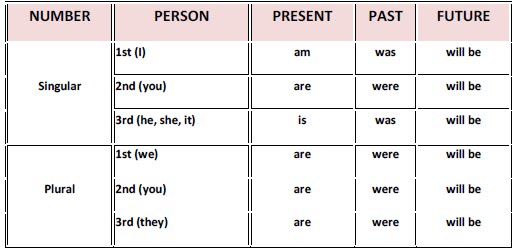
A verb must "agree" with its subject. Subject-verb agreement generally means that the third person singular verb form must be used with a third person subject in the simple present tense. The word be - the most irregular and also most common verb in English - has different forms for each person and even for the simple past tense. The forms of the word be are given in the chart below:


Usually a subject comes before a verb and an object may come after it. The subject is what does the action of the verb and the object is what receives the action. In the sentence Bob ate a humburger, Bob is the subject or the one who did the eating and the hamburger is the object or what got eaten. A verb which has an object is called a transitive verb and some examples are throw, buy, hit, love. A verb which has no object is called an intransitive verb and some examples are go, come, walk, listen.

As you can see in the charts above, verbs are often made up of more than one word. The future forms, for example, use the word will and the perfect forms use the word have. These words are called helping or auxiliary verbs. The word be can serve as an auxiliary and will and shall are also auxiliary forms. The chart below shows two other verbs which can also be used as auxiliaries:


There is a type of auxiliary verb called a modal which changes the meaning of a verb in different ways. Words like can, should, would, may, might, and must are modals and are covered in other lessons.

Adjectives

An adjective is often defined as a word which describes or gives more information about a noun or pronoun. Adjectives describe nouns in terms of such qualities as size, color, number, and kind. In the sentence The lazy dog sat on the rug, the word lazy is an adjective which gives more information about the noun dog. We can add more adjectives to describe the dog as well as in the sentence The lazy, old, brown dog sat on the rug. We can also add adjectives to describe the rug as in the sentence The lazy, old, brown dog sat on the beautiful, expensive, new rug. The adjectives do not change the basic meaning or structure of the sentence, but they do give a lot more information about the dog and the rug. As you can see in the example above, when more than one adjective is used, a comma (,) is used between the adjectives.

Usually an adjective comes before the noun that it describes, as in tall man. It can also come after a form of the word be as in The man is tall. More than one adjective can be used in this position in the sentence The man is tall, dark and handsome.

Most adjectives do not change form whether the noun it describes is singular or plural. For example we say big tree and big trees, old house and old houses, good time and good times. There are, however, some adjectives that do have different singular and plural forms. The common words this and that have the plural forms these and those. These words are called demonstrative adjectives because demonstrate or point out what is being referred to.

Another common type of adjective is the possessive adjective which shows possession or ownership. The words my dog or my dogs indicate that the dog or dogsbelong to me. I would use the plural form our if the dog or dogsbelonged to me and other people. The chart below shows the forms of possessive adjectives.


*Person is used here as a grammar word and has these meanings:


  • 1st person or the self (I, me, we),
  • 2nd person or the person spoken to (you)
  • 3rd person or the person spoken about (he, she, him, her, they, them).

Adverbs

An adverb is usually defined as a word that gives more information about a verb, an adjective or another adverb. Adverbs describe verbs, adjectives and adverbs in terms of such qualities as time, frequency and manner. In the sentence Sue runs fast, fast describes how or the manner in which Sue runs. In the sentence Sue runs very fast, very describes the adverb fast and gives information about how fast Sue runs.

Most, but not all adverbs end in -ly as in But not all words that end in -ly are adverbs (ugly is an adjective, supply and reply can both be nouns or verbs). Many times an adjective can be made into an adverb by adding -ly as in nicely, quickly, completely, sincerely.

Adverbs of time tell when something happens and adverbs of frequency tell how often something happens. Below are some common adverbs of time and frequency which you should learn:

                     Adverbs of Time                   Adverbs of Frequency


Pronouns

A pronoun is often defined as a word which can be used instead of a noun. For example, instead of saying John is a student, the pronoun he can be used in place of the noun John and the sentence becomes He is a student. We use pronouns very often, especially so that we do not have to keep on repeating a noun. This chapter is about the kind of pronoun called a personal pronoun because it often refers to a person. Like nouns, personal pronouns sometimes have singular and plural forms (I-we, he-they).

Unlike nouns, personal pronouns sometimes have different forms for masculine/male, feminine/female and neuter (he-she-it). Also unlike nouns, personal pronouns have different forms depending on if they act as subjects or objects (he-him, she-her). A subject is a word which does an action and usually comes before the verb, and an object is a word that receives an action and usually comes after the verb. For example, in the sentence Yesterday Susan called her mother, Susan is the subject and mother is the object. The pronoun she can be used instead of Susan and the pronoun her can be used instead of mother. The form of a personal pronoun also changes according to what person is referred to. Person is used here as a grammar word and means:

  • 1st person or the self (I, me, we),
  • 2nd person or the person spoken to (you),
  • 3rd person or the person spoken about (he, she, him, her, they, them).

There is also a possessive form of the pronoun. Just as we can make a noun possessive as in the sentence That is my father's book to mean That is the book of my father, we can make the pronoun possessive and say That book is his. There are possessive adjective forms (such as my, your, his, her etc.) Possessive pronouns can stand by themselves without nouns, but possessive adjectives, like other adjectives, are used together with nouns.

There is also an intensive form of the pronoun which intensifies or emphasizes the noun that it comes after as in the sentence I myself saw him. The reflexive form of the pronoun looks exactly like the intensive form but is used when the subject and object of a verb refers to the same person as in the sentence I saw myself in the mirror.

All of this may sound confusing, but if you study the chart below, it will be clearer:


There are also interrogative pronouns (who, which, what) used for asking questions and relative pronouns (who, which, what, that) used in complex sentences which will be discussed in another place. Some grammar books also talk about demonstrative pronouns (this, that, these, those) and indefinite pronouns (some, all, both, each, etc.) which are very similar to adjectives and do not need to be discussed here.

Prepositions

A preposition is a word which shows relationships among other words in the sentence. The relationships include direction, place, time, cause, manner and amount. In the sentence She went to the store, to is a preposition which shows direction. In the sentence He came by bus, by is a preposition which shows manner. In the sentence They will be here at three o'clock, at is a preposition which shows time and in the sentence It is under the table, under is a preposition which shows place.

A preposition always goes with a noun or pronoun which is called the object of the preposition. The preposition is almost always before the noun or pronoun and that is why it is called a preposition. The preposition and the object of the preposition together are called a prepositional phrase. The following chart shows the prepositions, objects of the preposition, and prepositional phrases of the sentences above.


Prepositional phrases are like idioms and are best learned through listening to and reading as much as possible. Below are some common prepositions of time and place and examples of their use.

Prepositions of time:

  • at two o'clock
  • on Wednesday
  • in an hour, in January; in 1992
  • for a day
Prepositions of place:
  • at my house
  • in New York, in my hand
  • on the table
  • near the library
  • across the street
  • under the bed
  • between the books

Conjunctions

A conjunction is a word that connects other words or groups of words. In the sentence Bob and Dan are friends the conjunction and connects two nouns and in the sentence He will drive or fly, the conjunction or connects two verbs. In the sentence It is early but we can go, the conjunction but connects two groups of words.

Coordinating conjunctions are conjunctions which connect two equal parts of a sentence. The most common ones are and, or, but, and so which are used in the following ways:

  • and is used to join or add words together in the sentence:
They ate and drank.
  • or is used to show choice or possibilities as in the sentence:
 He will be here on Monday or Tuesday.
  • but is used to show opposite or conflicting ideas as in the sentence:
               She is small but strong.
  • so is used to show result as in the sentence:
                I was tired so I went to sleep.

Subordinating conjunctions connect two parts of a sentence that are not equal and will be discussed more in another class. For now, you should know some of the more common subordinating conjunctions such as:

after      before    unless

although     if        until

as        since         when

because      than     while

Correlative conjunctions are pairs of conjunctions that work together. In the sentence Both Jan and Meg are good swimmers, both . . .and are correlative conjunctions. The most common correlative conjunctions are:

  • both . . .and
  • either . . . or
  • neither . . . nor
  • not only . . . but also
Articles

An article is a word which is always used with and gives some information about a noun. There are only two articles a and the, but they are used very often and are important for using English accurately.

The word a (which becomes an when the next word begins with a vowel - a, e, i, o, u) is called the indefinite article because the noun it goes with is indefinite or general. The meaning of the article a is similar to the number one, but one is stronger and gives more emphasis. It is possible to say I have a book or I have one book, but the second sentence emphasizes that I do not have two or three or some other number of books.

The word the is known as the definite article and indicates a specific thing. The difference between the sentences I sat on a chair and I sat on the chair is that the second sentence refers to a particular, specific chair, not just any chair.

Many nouns, especially singular forms of countable nouns which you will learn about later, must have an article. In English, it is not possible to say I sat on chair without an article, but a demonstrative or possessive adjective can be used instead of an article as in the sentences I sat on that chair and I sat on his chair.

Whenever you see an article, you will find a noun with it. The noun may be the next word as in the man or there may be adjectives and perhaps adverbs between the article and the noun as in the very angry, young man.

Identification of Parts of Speech

Now that you have learned all the parts of speech, you can identify the words in a sentence. This section will give you some clues that will make identification easier.

First of all, a word can be more than one part of speech and you have to look at how the word works in a particular sentence to know what part of speech it is. The chart below shows examples of words that have more than one part of speech.


The verb is the heart of a sentence, so it is a good idea to identify the verb first when looking at a sentence. Verbs can be recognized through:

  • past tense ending (looked)

  • 3rd person singular ending (says)

  • auxiliary verb (will see)

  • modal verb (can hear)
There are also verb endings or suffixes that can help you recognize verbs.

SOURCE:
Grammar:©2002 INTERLINK LanguageCenters - Created by Mark Feder

12 March, 2010

Lecture 2- Phrasal Categories

Phrasal Categories: (syntactic labels): NP, VP, PP, Adj, Adv, Det, Linear order and internal hierarchical structure. Just as morphemes have morpheme categories, and words have word categories, phrases have phrasal categories.
• Phrasal categories, just like word categories, are ultimately much more useful than just individual phrases, for the study of sentence structure. A phrasal category is directly determined by the category of the word which the phrase is about. Such a word is called the head of the phrase.
How to determine a phrasal category:
The concept of a “head”
• The head of a phrase is the main word of that phrase. It is essentially what the entire phrase is about.
• The category of a phrase is directly determined from the category of its head.
To see how this works, consider the following example sentence, with the phrases marked out in brackets:

(1) [The tiny woman] [went [to [the store ] ] ]

Sentence (S) = The tiny woman went to the store

Phrase 1 = the tiny woman

Phrase 2 = went to the store

Phrase 3 = to the store

Phrase 4 = the store

What is the head of Phrase 1?
In other words, what is Phrase 1 mainly about? What does it refer to in the real world?
It is essentially talking about a woman. The other words the and tiny give us more information about the woman but this is extra information. The main word in the phrase is woman.
So, the head of Phrase 1 is woman.
Determining the phrase category
What is the category of woman? It is a noun.
• The category of the phrase is determined by the word category of its head.
• The word category of the head is: Noun.
• Therefore, the phrasal category of Phrase 1 is: Noun Phrase (NP, for short).
Similarly, in Phrase 2, the head is: went because this is the main information.
That the woman went to the store (and not somewhere else) is extra information. So, the head of Phrase 2 is: went. The word- category of went is verb. So, Phrase 2 is a Verb Phrase (VP).
In Phrase 3, the head is: to. Even if it doesn’t seem so obvious, the phrase is actually talking about the woman going to a place, so the head of this phrase is to. The category of to is preposition. So,Phrase 3 is a Prepositional Phrase (PP).

Lecture 1- Preliminaries

Syntax is the branch of linguistics which deals with the study of sentence structure.

Syntactic categories
A syntactic category is either a phrasal category, such as noun phrase or verb phrase, which can be decomposed into smaller syntactic categories, or a lexical category, such as noun or verb, which cannot be further decomposed.
The three criteria used in defining syntactic categories are:
1. The type of meaning it expresses.
2. The type of affixes it takes.
3. The structure in which it occurs.
In terms of phrase structure rules, phrasal categories can occur to the left side of the arrow while lexical categories cannot.
The lexical categories are traditionally called the parts of speech. They include nouns, verbs, adjectives, and so on.
words are the units that make up a sentence.
• This is indeed true and a study of words and, especially, of the categories of words (like NOUN, VERB, ADJECTIVE) is crucial to understanding sentence structure.
Word categories
Word categories are crucial to the study of sentence structure. In fact, they are more important than words.
• When we say word category, we mean categories like NOUN, VERB, ADJECTIVE but also less well-known categories, which we’ll learn about, like determiner and auxiliary.
• In last week’s class, we also referred to a word category as part-of-speech. These two things mean exactly the same thing.
Why are word categories more important than words
Words vs. word categories
Before we go on to study word categories, it is important to ask this question:
Why are word categories more important than words for sentence structure?
Here’s why word-categories are more important than words:
Reason 1: Different words, same word categories.
• What makes one sentence different from another sentence?
(i) Each sentence has different words
(ii) Each sentence has a different order of words.
• So a sentence analysis which only looks at the words (and the order in which these particular words occur) in a sentence - will only be relevant to that particular sentence, not to any other.
• Such an analysis will not be very interesting because it cannot be used to generalize about other sentences or to understand how other sentences are structured in a language.
• However, word categories (like NOUN, VERB, ADJECTIVE, etc) are shared by all sentences.
• So an analysis that is made in terms of word categories and their relative order in a sentence is a better analysis than one that is based on individual words.
Example:
(2) This child cries.
(3) The bird sings.
• Both sentences have completely different words.
• And yet, in terms of word-categories, the two sentences have the same structure, which can be represented as :ARTICLE - NOUN - VERB
• If we just studied individual words, we would have no clue that these sentences actually have the same structure. Each sentence would then get a different “structure” because they have different words - and we would miss the similarity in the structure of the two sentences entirely.
Reason 2: A sentence can contain an infinite number of words.
Consider the following sentence:
(4) I saw the child on the swing under the apple tree in the garden by the white fence that was along the road with the cars . . .
• It’s simply not practical, or possible, to study the individual words in the above sentence because there could be an infinite number of words in it!
• It’s much easier to study word categories because we can then generalize across several types of words.
• For e.g., we could say that the above sentence just has a standard NOUN-VERB-NOUN structure that is then followed by a repeating pattern of PREPOSITIONS followed by ARTICLES and NOUNS.

The myth about word categories

Word categories

Now that we have seen that word categories are so important, let’s look at them!
You might have already learned to identify categories like NOUN, VERB, ADJECTIVE, PREPOSITION, ADVERB and so on, as follows:
• A NOUN is a person, place, or thing.
• An ADJECTIVE describes qualities typical of a NOUN.
• A VERB denotes an action, event, state, or emotion.
• An ADVERB describes qualities of a VERB, ADJECTIVE, or other ADVERB.
• A PREPOSITION describes a spatial or temporal relation, direction toward or away from something, and alternatives (except, despite).
These descriptions of the meanings of word categories are definitely helpful to some degree.
Because of descriptions like these, you can easily identify the categories or parts of speech of sentences like this:
(5) John drives very fast on highways. (NOUN = John, highways; VERB = drives; ADVERB = very; ADJECTIVE = fast; PREPOSITION = on)
But what about sentences like this?
(6) I wondered whether he felt too angry.
(7) His destruction of the school was terrible
(8) In order for such a plan to work, we need lots of money!
(9) It is raining.
• Of course, we can identify some words like assumptions, and light bulb as NOUNS and we can also identify some other words like felt, work and raining.
• But what about words like order in example (8)? We know that it must be a NOUN, but we couldn’t really know that from the definition for NOUN above: it’s not a person or a place, but it doesn’t really seem to be a thing either‘.
• And what about destruction in (7)? ‘DESTRUCTION' is a type of action and, according to our definition, it should be a VERB. But we very well know that it’s not a VERB; that it is, in fact, a NOUN!
• Finally, words like whether in (6), a in (8), and it in (9) don’t seem to have any clear meaning at all.
Nonsense words
Examples like the above suggest that a mere semantic description of the word categories is not enough.
But conclusive evidence that they are not all that helpful at all comes from examples like the famous Jabberwocky poem by Lewis Carroll.
Jabberwocky, by Lewis Carrol
‘Twas brillig, and the slithy toves
Did gyre and gimble in the wabe;
All mimsy were the borogoves,
And the mome raths outgrabe.
Beware the Jabberwock, my son!
The jaws that bite, the claws that catch!
Beware the Jubjub bird, and shun
The frumious bandersnatch!
The above poem contains some actual English words, but it also contains several words above that are not English but nonsense-words.
• And still, we can identify what word categories these nonsense words belong to!
The fact that you can identify the word categories of nonsense words or words that have no semantic meaning whatsoever shows that there is more to a word category than just semantic meaning.So we need a better way to describe word categories - one that doesn’t just use semantic descriptions of NOUNS, VERBS, . . . .
A better definition for word categories
Two things probably helped you to figure out the category of the nonsense words:
• The affixes on the word. e.g. the morpheme -ous in frumious.
• The position of the word in the sentence gives a further clue. e.g. that Jabberwocky occurs immediately after the.
• Evidence like word-affixes constitute morphological properties of word categories; the affixes themselves are called morphemes.
• Evidence like word position constitute syntactic properties of word categories.
• Together, the morphological and syntactic properties of a word provide far more effective evidence for determining word categories than semantic properties.
We can now provide better definitions for word categories like NOUN, VERB, ADJECTIVE, ADVERB and PREPOSITION (for English) in terms of their syntactic and morphological properties.
Sources: